by Bernie Kluger and Rebecca Schewe, PhD
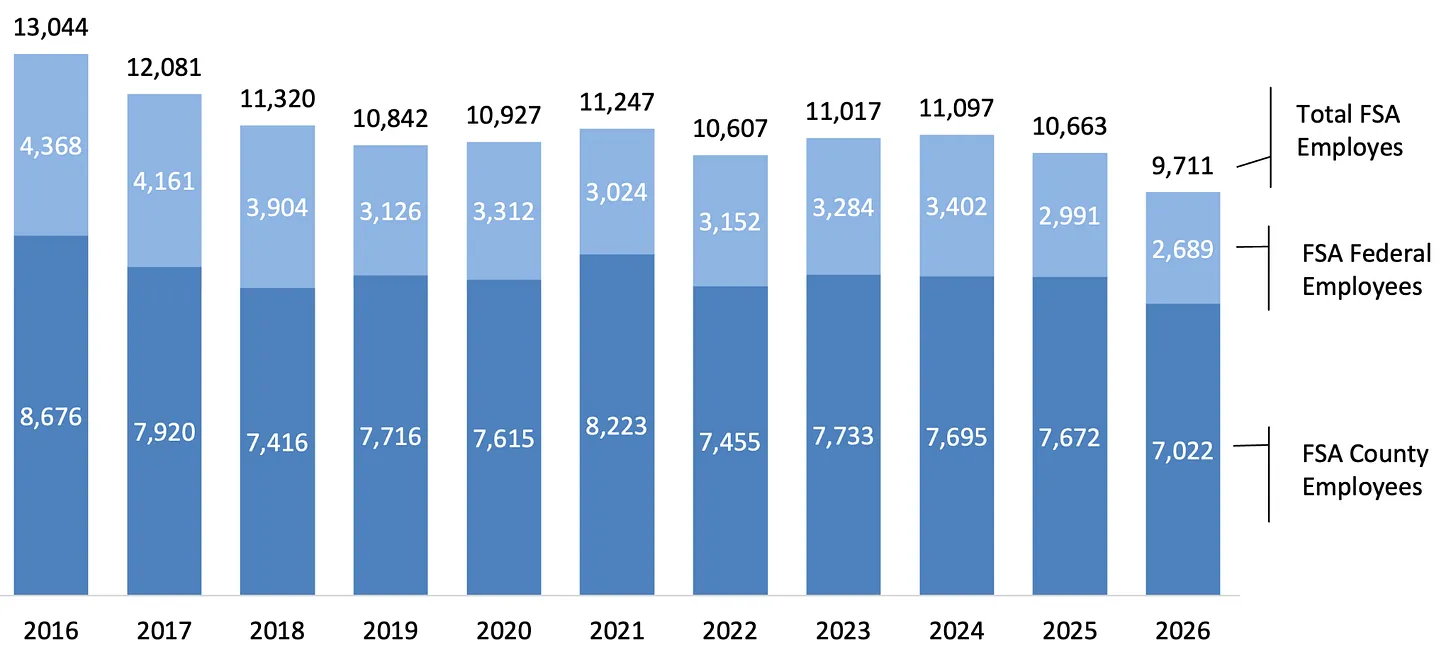
Figure 1: Count of FSA County and FSA Federal Employees
(January 31, 2016- January 31, 2026)

Prospect Partners and the National Sustainable Agriculture Coalition (NSAC) obtained federal employment information through a Freedom of Information Act Request (FOIA). The data showed that in 2025, the US Department of Agriculture (USDA) reduced by 8% the number of front line staff, known as FSA County Employees, at the USDA Farm Service Agency (FSA), Over one third of FSA local offices were experienced net staffing declines by year’s end, with 42 offices ending 2025 with no FSA County staff. Cuts to FSA County staff were USDA’s largest termination of community presence in over a decade and may signal a break with longstanding USDA commitment to direct service to farmers and local community representation in hiring and management. Bernie Kluger, Prospect Partners LLC, and Dr. Becky Schewe, National Sustainable Agriculture Coalition (NSAC), analyzed the newly available FSA County staff records, publishing their findings in early June 2026. As a follow-up, the authors recently sat down to discuss the context and significance of their research.
Bernie: We have been hearing a lot of disagreement about whether or not USDA is closing local offices, with official statements saying offices are open and farmers saying the lights are off at their local office. Does this new federal data finally answer the question?
Becky: The FSA County staff data really gives us a whole new perspective on how devastating USDA staffing losses are for farmers and ranchers. FSA County staff are probably the most farmer-facing staff in the USDA. They work directly with farmers and ranchers every day to help them access loans and federal programs, and now for the first time we’re able to see how many counties lost these vital staff. It is shocking to see the extent of these losses and how many farmers will now not have local staff to turn to for support during an extremely challenging time. FSA County staff are not usually reported when considering the federal workforce, but their local presence is vital for farmers, so seeing the losses that many counties faced shows the real loss of local relationships and support.
Bernie: What is the difference between the work that is done by local FSA County employees and local FSA federal employees?
Becky: Both FSA County staff and FSA federal employees work with farmers and ranchers to help them access federal programs and loans, but what is unique about FSA County staff is that they are hired and managed locally. Every FSA office in the country is required by law to have an advisory board, called a County Committee, made up of local elected farmers and ranchers. FSA County employees are hired by and report directly to these locally elected committees. This ensures a strong local connection for FSA County staff who provide front-line services to farmers and ranchers.
Bernie: What drives your interest in FSA staffing numbers? Why is this an important issue for you?
Becky: As a rural sociologist I’ve spent twenty years understanding and advocating for rural communities. It has always been clear to me that USDA staff, and especially FSA staff, support those communities. FSA is there for farmers and ranchers during their hardest times. Helping beginning farmers navigate loans and credit, helping people recover from disasters, and providing the day-in and day-out support that farmers and ranchers need. NSAC, where I work today, is a grassroots member-based coalition, and our members know that good programs only work with good staff to support them.
Figure 2: Net Staffing Change Among FSA County Employees in US Counties (January 31, 2025-January 31, 2026)

Bernie: I strongly agree with you. In my experience, it is true across the federal government that good government depends on having good staff.
Becky: You had served previously at both the US Office and Personnel Management and USDA, where you advised the Agriculture Secretary on workforce and agency administration. Can you help us understand why this data hasn’t been available before now?
Bernie: FSA County staff constitute one of the largest, long-standing, and consequential segments of the federal workforce, with around 7000 employees. But in Washington they are largely invisible, sharing many of the rights and benefits that federal employees have, but without the legal status of federal employees. As a result, whenever OPM takes count of the federal workforce, the agency has historically overlooked FSA County staff. It’s actually very similar to the status of postal workers, who also do not appear in most federal statistics as federal employees, except in counts taken by the Census and Bureau of Labor Statistics. No one is actually trying to hide the staff data, but it would certainly help if Congress authorized and funded its inclusion in OPM statistical reporting. FSA was very accommodating in its response to our FOIA, but it would make more sense and cost less to the taxpayer to have FSA County employee data included in monthly OPM public data releases at data.opm.gov.
Bernie: Maintaining over two thousand offices seems like a lot of expense. What is the point of having so many offices?
Unlike most federal offices, FSA county offices have a legal responsibility to gather local community input and the independence to use that input in their daily operations. This includes decisions on hiring. Since the 1930’s, County Committees have provided grassroots input that shapes FSA programs and hiring. Historically, approximately two-thirds of the FSA workforce have actually served as employees of these local committees, not the federal government. They are the staff we learned about in our FOIA and, as you noted earlier, are commonly referred to as FSA County Office (FSACO) employees.
Bernie: It sounds like FSA has been practicing for almost a century the kind of local democratic co-creation that organizations like Popvox and Recoding America or scholars like Hollie Russon Gilman, and Elizabeth Linos have been advocating for. I can see why the elimination of staff in so many counties – without the involvement of the locally elected county committees – would be so upsetting. But in county offices, it’s at the heart of their mission. This isn’t just a marketing gimmick, local input on staffing is a century old principle. Eliminating staff in hundreds of offices without local consultation is a meaningful departure from the social contract.
Becky: USDA leadership has been talking about replacing many of its program applications with a single “one farmer, one file” technology solution. Based on your experience leading federal technology and streamlining projects, do you think we can make up for the loss of staff with AI?
Bernie: Something I learned from Anne Lewis, a colleague at SBA, is that the push to “use AI” is the wrong starting point. Technology investments are important, but there is nothing that can replace a direct, personal conversation with real people about what’s working and what needs to be fixed. Instead, it is sounding like FSA is planning to replace one centrally planned “solution” with another, and without meaningful public involvement. Don Moynihan and Jamilah Michener, among others, have observed that without meaningful public engagement, continuous feedback loops, or attention on day-to-interactions between citizens and government service providers, projects like “one farmer, one file” can actually add to administrative burden. I saw this first-hand during the launch of USAJOBS.gov and, more recently, with SBA COVID relief, where centrally driven solutions can lead to catastrophic waste.
Turning the conversation back to “one farmer, one file” I am concerned whether this investment will actually improve the lives of farmers and ranchers, save taxpayer dollars, or elevate American competitiveness. Replacing two paper forms with one form doesn’t help if you still need to hire an accountant and civil engineer and lawyer to complete one application. On top of that, the current plan seems to move entire programs online, which ignores that the digital divide continues to be very real in rural America. There are also some emerging problems in how USDA is approaching the task.
In this transitional period between the sudden loss of front line county staff and the implementation of something new, staffing cuts will further strain communication between farmers and ranchers and Washington at the exact moment when feedback is most important. Without local consultation on what comes next, we may end up with new tech that actually increases administrative burden on farmers and ranchers.
Methodology
Analysis by National Sustainable Agriculture Coalition and Prospect Partners, LLC, based on federal data. FSA County data released to NSAC and Prospect Partners on April 8, 2026 by the Farm Service Administration in response to our Freedom of Information Act (FOIA) request. FSA federal data obtained on April 9, 2026 from the US Office of Personnel Management through http://data.opm.gov.
Employment details of FSA County staff have not been regularly reported by the Office of Personnel Management (OPM) since county staff are non-federal employees and technically employees of the local elected FSA County committees. To obtain data on FSA County staff changes, NSAC and Prospect Partners prepared a Freedom of Information Act (FOIA) request to the FSA requesting monthly snapshots of FSA County employees from January 2016 to January 2026. On April 8, 2026, FSA responded to our FOIA request with aggregate counts of employees for each office, county, and state as well as aggregate counts of positions, grades, and tenure.
Co-author: Rebecca Schewe, Ph.D.. National Sustainable Agriculture Coalition
Becky has spent nearly twenty years researching agriculture, rural communities, and the environment. She holds an M.S. in Rural Sociology and a Ph.D. in Sociology from the University of Wisconsin-Madison. She is a passionate advocate for a sustainable agricultural and food system and evidence-based policy. She comes to NSAC from the Maxwell School for Citizenship and Public Affairs at Syracuse University where she has researched agricultural and food system policy impacts, conservation behaviors, and their connection with social systems like labor equity.